How Much Does It Cost to Build an AI Agent? (2026 Guide)
AI agent development costs range from $10K to $400K+. Here's what actually drives the price and how to budget for one that works in production.
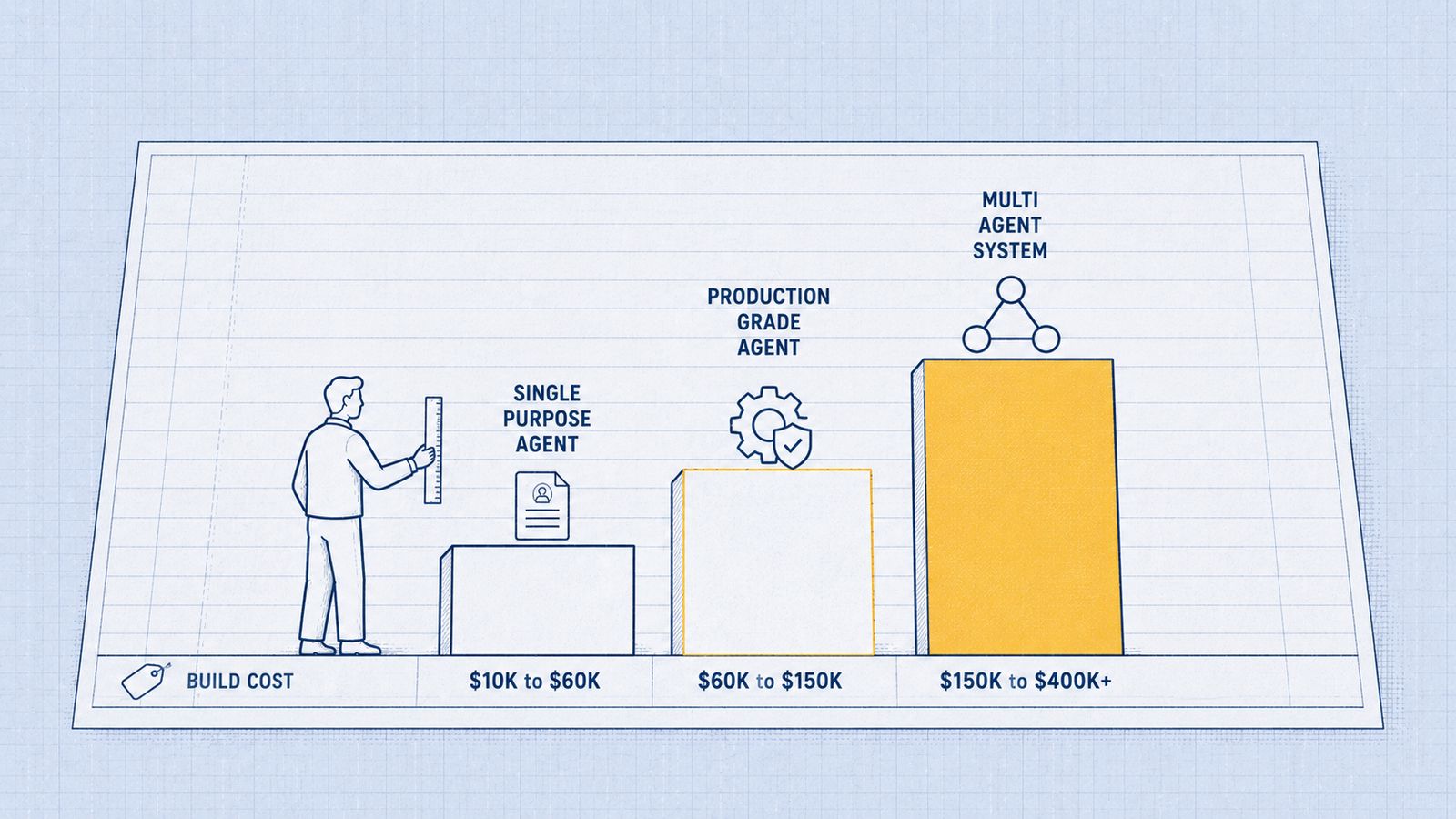
How much does it cost to build an AI agent?
Building an AI agent typically costs between $10,000 and $400,000+, depending on complexity. A simple single-purpose agent - a lead qualifier or document parser - runs $10K–$50K. A production-grade agent with memory, tool integrations, and guardrails costs $50K to $150K. A multi-agent orchestration system for enterprise workflows starts at $150K and can scale well beyond $400K. The build cost is only part of the picture - ongoing LLM API costs, monitoring, and eval pipelines add 20 to 40% to total annual cost of ownership.
AI agent development cost ranges from $10,000 for a focused single-purpose build to over $400K for an enterprise-grade autonomous workflow platform. Most cost guides online give ranges so wide they're useless. This one breaks down what actually moves the number - up or down - based on real builds, so you can walk into any vendor conversation with accurate expectations.
According to McKinsey's State of AI 2025 report, 72% of organizations now use generative AI but only 6% qualify as high performers. The gap between those groups isn't ambition - it's the quality of what they built and how they budgeted for it.
The short answer: AI agent cost by type
The fastest way to orient your budget is by agent type. Complexity of reasoning, number of integrations, and whether the system needs to survive production traffic are the three biggest cost levers. This table gives you a realistic starting point before we break down every driver below.
| Agent type | What it Does | Typical Cost Range | Timeline |
|---|---|---|---|
| Rule-based / scripted agent | Fixed decision tree, no real LLM reasoning | $5K–$10K | 2 to 4 weeks |
| Single-purpose LLM agent | One task, one tool set (e.g., lead qualifier, doc parser) | $15K–$30K | 4 to 8 weeks |
| Production-grade agent | Memory, multiple tool integrations, evals, guardrails | $40K–$100K | 8 to 14 weeks |
| Multi-agent system | Specialised agents working in orchestration | $150K–$200K+ | 3 to 6 months |
| Enterprise agentic platform | Autonomous workflows at scale, compliance, monitoring | $400K+ | 6 to 18 months |
These are build costs from a specialist agency. Freelancer rates are lower upfront; in-house team rates are higher when you factor in time-to-hire and ramp time. Both are covered later in this guide.
The 7 things that actually determine your AI agent development cost
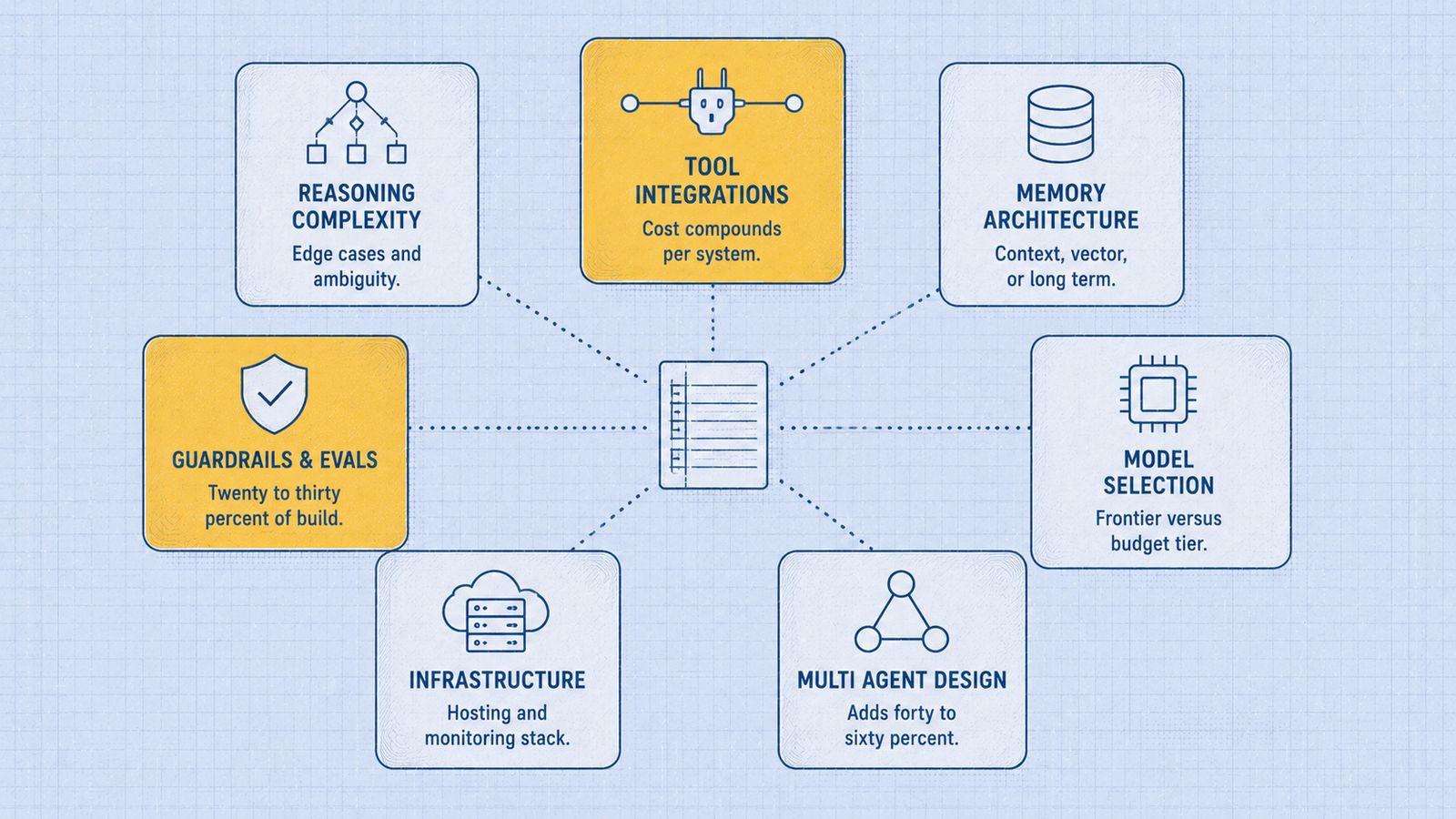
Most cost guides list "complexity" as a driver and leave it there. These are the seven specific variables that a well-run scoping conversation will surface and that will directly determine the number on your quote.
1. Complexity of reasoning required
The more decision branches, edge cases, and ambiguity the agent must handle, the longer and more expensive the build. A lead qualifier with five fixed criteria is a tractable engineering problem. An agent that reads a contract, identifies non-standard clauses, cross-references regulatory requirements, and flags risk across jurisdictions is a fundamentally different challenge. Every layer of reasoning adds prompt engineering time, test coverage requirements, and evaluation overhead - none of which is cheap to do properly.
2. Number and depth of tool integrations
Every external system the agent connects to adds scope: CRMs (Salesforce, HubSpot), databases, calendars, telephony APIs, email providers, internal tools. The relationship between integrations and cost is not linear. A simple agent with two integrations versus one with twelve is not six times the work. It is often fifteen times, because edge cases compound across every system boundary. Budget $2,000 to $4,000 on integrations depending on API quality, security requirements, and workflow complexity.
3. Memory architecture
Whether the agent needs to remember things - and how - is one of the most consequential architecture decisions in the build. There are three types:
- In-context memory: cheapest, limited to the current conversation window; the agent forgets everything when the session ends
- External memory (vector database): moderate cost, enables the agent to recall past interactions and retrieve relevant documents using semantic search
- Episodic / long-term memory: most complex, the agent builds a persistent model of a user or situation over time
Most production agents need external memory. Designing, building, and maintaining a vector database layer( Pinecone, Weaviate etc.) adds $3,000 to $15,000 to the build depending on data scale and query volume.
4. Guardrails, evals, and fallback logic
This is the line between a demo and a production system and it is precisely where most cheap builds cut corners. Guardrails prevent the agent from going off-policy: saying something it shouldn't, taking an action outside its authority, or hallucinating a response when it should escalate. Evals are automated test suites that verify the agent is still performing correctly after every change to prompts, models, or connected systems. Fallback logic determines what happens when the agent doesn't know what to do; escalate to a human, return a safe default, log for review.
Budget 20 to 30% of total build cost for this layer. If a vendor doesn't mention evals during the scoping conversation, that is a red flag. Skipping this layer means your agent performs in the demo and fails silently in production; sometimes in ways that damage customer relationships before anyone notices.
5. LLM selection and API cost
The underlying model - GPT-4o, Claude Sonnet, Gemini Flash, or an open-source model like Llama - affects both build cost and ongoing running costs. Frontier models produce better reasoning out of the box but cost more per token and require less prompt engineering to achieve acceptable accuracy. Smaller models are cheaper per query but may require significantly more engineering time to get to the same accuracy threshold.
For 10,000 monthly interactions, costs typically range from hundreds of dollars on budget models to several thousand dollars on frontier models, depending on context length, tool use, and reasoning depth.
6. Infrastructure and deployment environment
Where the agent runs matters more than most buyers realize until the invoice arrives. A simple agent on a serverless function (AWS Lambda, Vercel) costs almost nothing to host. A complex multi-agent system with a vector database, Redis cache, message queue (RabbitMQ), monitoring stack (Datadog, LangSmith), and horizontal scaling requires proper cloud infrastructure; budget $500 to $3,000 per month in ongoing infrastructure costs, depending on load and redundancy requirements.
7. Multi-agent vs Single-agent architecture
A single agent has one brain, one set of tools, one purpose. A multi-agent system has specialised sub-agents that orchestrate together - a researcher, a writer, a fact-checker, a publisher - communicating via an orchestration layer such as LangGraph, CrewAI, or a custom-built coordinator. Multi-agent systems unlock significantly more powerful automation but add architectural complexity that compounds at every layer.
As a rule: double your development timeline estimate and add 40–60% to the budget when you move from single to multi-agent architecture.
Build cost vs. total cost of ownership: the number most guides ignore
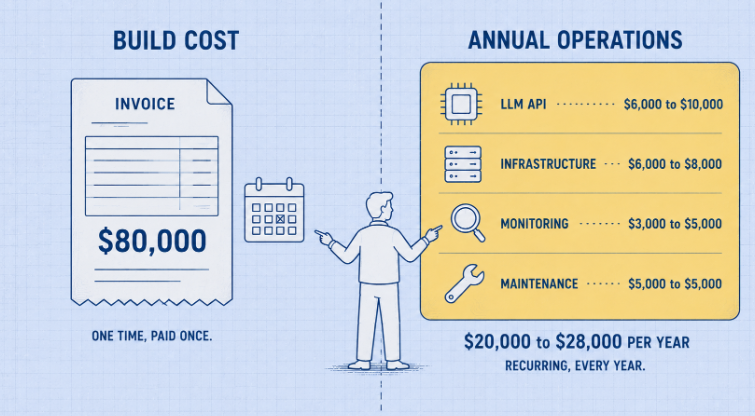
The build invoice is a one-time cost. Total cost of ownership runs every year the agent is live. Most buyers focus exclusively on the build and then experience sticker shock when they see the first quarterly operations bill.
| Cost Component | Frequency | Typical Range |
|---|---|---|
| LLM API usage | Monthly | $200 - $5,000+/month (depending on the LLM model) |
| Cloud infrastructure | Monthly | $300 - $3,000+/month |
| Monitoring and observability | Monthly | $100 to $500/month |
| Eval runs and regression testing | Per deployment | $100 - $500/run |
| Prompt updates and maintenance | Quarterly | $2,000 - $5,000/quarter |
| Model upgrades and re-evaluation | Annual | $5,000 - $30,000/year (depending on the model and evaluation metrics) |
Rule of thumb: budget 25 to 35% of the build cost annually for maintenance and operations.
An agent built for $80,000 will cost roughly $20,000 to $28,000 per year to run and maintain correctly and that figure assumes someone is actively monitoring it, not just hoping it continues to work.
Prompt drift is also a real and under-discussed risk. When the underlying LLM provider updates their model, your agent's behavior can change without a single line of code being touched. Production-grade operations include scheduled eval runs specifically to catch this.
Build in-house vs. hire an agency vs. use freelancers
The right answer depends on what AI is to your business; core product or operational tool.
Each path has a different real cost structure that vendor conversations rarely surface honestly.
Building in-house
In-house development gives you full control, IP ownership, and a team that builds institutional knowledge as they go. The constraint is time: hiring a capable team - ML engineer, backend engineer, prompt engineer - takes 3 to 6 months in the current market. Then add 3 to 6 months to ship something production-ready. Real total cost in year one, including salaries, benefits, recruiting fees, and ramp time: $300,000 to $600,000 for a team capable of building a production-grade agent.
Best for: companies where AI is the core product, not a feature they're adding to an existing one.
Hiring a specialist AI development agency
An agency brings a full team on day one - no hiring lag, no ramp time, and production experience across multiple prior builds. The tradeoff is a higher day-rate than freelancers and the need for an active, well-defined engagement from your side. Real total cost for a production-ready AI agent: $30,000 to $100,000 depending on scope, with a timeline of 6–16 weeks.
Best for: founders and product teams who need to ship on a defined timeline and cannot absorb a 6-month hiring cycle.
Using freelancers
Freelancers offer the lowest upfront cost and maximum flexibility. The structural problem: most freelancers can build a convincing demo, but very few have the full-stack range to ship a production system - ML, backend, infrastructure, evals, UX, and security. Coordination overhead is real, and the hidden cost of debugging and rewriting work that wasn't built to production standards frequently brings the total cost above what a specialist agency would have charged.
Best for: very early PoC validation before you commit to a full build.
| Scenario | Recommended Path |
|---|---|
| Need a PoC in 2 weeks to show investors | Freelancer or small agency |
| Need a production agent shipped in 8 weeks | Specialist AI agency |
| Building AI as core product, have runway | In-house team |
| Need a multi-agent enterprise system | Specialist AI agency + in-house hybrid |
What a realistic project timeline looks like
Founders consistently underestimate this. The timeline below reflects what a disciplined, well-resourced build actually looks like; not the optimistic version you see in sales proposals.
Weeks 1–2: Discovery and architecture.
Define the agent's goal, the tools it needs access to, the edge cases it must handle, and what "done" looks like in measurable terms. The cleaner this phase is, the cheaper the build. Skipping or rushing discovery is the single most expensive mistake in AI development - ambiguity discovered in week 8 costs ten times what it costs to resolve in week 1.
Weeks 3–6: Core agent build.
LLM integration, tool connections, memory architecture, base prompt engineering. The first working version exists internally by the end of this phase. It will not be production-ready yet that distinction matters.
Weeks 7–9: Evals, guardrails, and edge case handling.
This phase is not optional, and it cannot be compressed without directly reducing production reliability. Running evals on 200 to 500 real-world test cases, building fallback logic, and connecting monitoring adds 30 to 40% to the timeline. It is also the phase that determines whether the agent works when real users and real data hit it.
Weeks 10–12: Integration, staging, and deployment.
Connecting to live systems, load testing, authentication, logging, cost controls. Deployment to production with rollback capability in place.
Week 13 onwards: Monitoring and iteration.
Track performance metrics, catch prompt drift, adjust as real-world data surfaces edge cases the test suite didn't cover. The agent improves — or degrades — almost entirely based on how well this phase is managed.
How to scope your AI agent project before getting a quote
Before you talk to any development team - agency or freelancer - have clear answers to these five questions. They will shorten your discovery phase, sharpen the quote you receive, and reduce the chance of a spec that expands mid-build.
1. What is the one thing you want the agent to do? Start with one, not ten. Multi-purpose ambition is the primary driver of scope creep and budget overruns.
2. What data does it need access to? CRM records? Documents? Live web data? Your internal database? Each data source is a distinct integration with its own cost and complexity.
3. What action does it take when it's confident? Send an email? Update a record? Book a calendar event? Make an outbound call? The action set determines the tool set.
4. What happens when it's not confident? Escalate to a human? Log for review? Return a safe default response? This is the fallback logic question, and a vendor who doesn't ask it isn't thinking about production.
5. What does success look like in numbers? 90% accuracy on a defined task? Handle 500 queries per day? Reduce a specific manual process by 60%? Measurable success criteria are how you evaluate whether the build delivered what you paid for.
Teams that arrive at the first scoping call with answers to all five get more accurate quotes, shorter discovery phases, and better final products. Teams that don't frequently fund builds that miss what they actually need.
Conclusion
The cost of an AI agent isn't just the build invoice. It's the build, the infrastructure, the ongoing operations, and the cost of getting it wrong the first time. The difference between a $30,000 demo and a $100,000 production system isn't the feature list. It's the evals, guardrails, and monitoring that make the feature list actually work under real conditions. Budget for the whole system, not just the parts that are visible in a demo.
Every build includes evals, guardrails, cost controls, and monitoring as standard; not optional add-ons. Week one is always working software, not slides. We scope the system around what you are actually trying to automate, not a generic template we've built before.
Send us the problem you're trying to solve and what success looks like in concrete terms. We'll respond with a mini roadmap, the key risks we'd want to address, and a realistic cost range - no obligation.
Specialist AI agency + in-house hybrid
Frequently Asked Questions:
1) How much does a simple AI agent cost?
A simple, single-purpose AI agent - one that handles one type of task, connects to one or two systems, and doesn't require complex memory or multi-step reasoning - typically costs $10,000–$35,000 to build. Expect 3 to 6 weeks for development and testing. Ongoing API and infrastructure costs usually run $300 to $1,000 per month at moderate usage volumes.
2) Can I build an AI agent for free?
You can prototype one using open-source tools (LangChain, LlamaIndex) and free-tier LLM APIs. Building a production-ready agent, one that handles real users, integrates with live systems, and includes monitoring and fallback logic, reliably requires engineering time and infrastructure that has real cost. Free prototypes are useful for validating a concept; they are not a substitute for a production build.
3) Why do AI agent quotes vary so much between vendors?
Two main reasons: scope definition and quality assumptions. A quote for a "lead qualification agent" can range from $8,000 to $120,000 depending on what's included; integrations, memory architecture, evals, guardrails, monitoring. Always ask vendors to itemise their estimate line by line so you can compare what is actually included, not just the total number.
4) Is it cheaper to use a no-code AI agent builder?
No-code platforms (Voiceflow, Relevance AI, Make) can get a working prototype deployed faster and at lower initial cost. They become expensive at scale, hit hard walls when you need custom logic, and typically don't provide the control needed for production reliability. The right pattern: use them to validate the concept, then rebuild in code when the concept is proven and the volume justifies it.
5) How do I calculate ROI on an AI agent?
Identify the human cost of the task you're automating: hours per week × hourly rate × 52 weeks. If an agent replaces 20 hours per week of work at $50 per hour, that is $52,000 per year in recovered capacity. A $60,000 build with $15,000 per year in running costs pays back in roughly 18 months before accounting for revenue upside from faster response times or the ability to handle volume that a human team couldn't absorb.