AI Voice Agents for Business: The Complete 2026 Guide
AI voice agents handle real phone calls - booking, support, and sales - without scripts breaking. Here's how they work, what they cost, and where to start.
What is an AI voice agent?
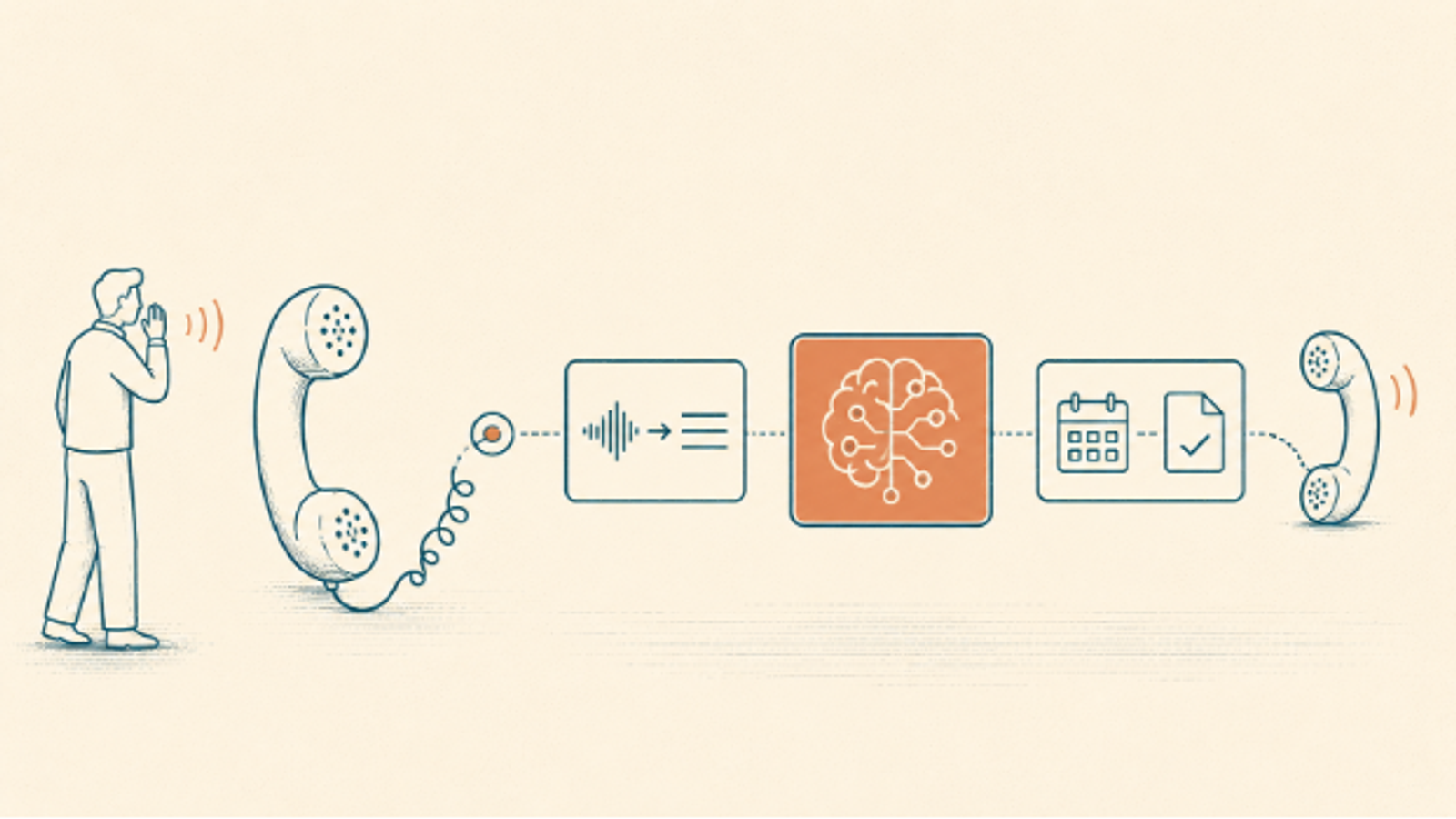
An AI voice agent is software that conducts real phone conversations — answering calls, asking questions, understanding responses, and taking action — without a human on the line. It combines speech recognition, an LLM for reasoning, and voice synthesis to sound and respond like a person, while writing results directly into your CRM or business systems in real time. Businesses use AI voice agents to handle inbound support calls, qualify and book sales leads, and run outbound campaigns 24/7, at a fraction of the cost of a human team. Forrester research found enterprises deploying voice AI saw a three-year ROI between 331% and 391%, with payback typically under six months.
An AI voice agent for business is software that handles real phone calls end-to-end - no hold music, no agent availability windows, no scripts that break the moment a caller goes off-piste. Voice AI moved from pilot program to production infrastructure faster than almost any other category of applied AI: production voice agent implementations grew 340% year-over-year across more than 500 organizations between 2024 and 2026. This guide covers exactly how they work, where they're already deployed, what they cost to build, and how to avoid the mistakes that sink most first deployments.
What exactly is an AI voice agent? (and how it's different from an IVR)
An AI voice agent is software that listens to what a caller says, understands what they mean, retrieves relevant information from your systems, and responds in natural spoken language - all in real time, without a human in the loop. (If you're exploring what is an AI agent more broadly before scoping a voice deployment, that's also worth reading first - voice agents are one implementation pattern within a larger architecture space.)
The distinction that matters most for buyers: a traditional IVR - Interactive Voice Response - is a fixed decision tree. Every path is pre-programmed. If a caller says something the system wasn't built to handle or simply speaks instead of pressing a button, the IVR fails. An AI voice agent understands open-ended speech. A caller can say "I need to reschedule my appointment from Thursday to sometime next week, preferably in the morning" and the agent handles it like pulling up the calendar, checking availability, confirming the change, and updating the booking system.
| Traditional IVR | AI Voice Agent | |
|---|---|---|
| Understands free speech | No (button presses only) | Yes |
| Handles unexpected questions | No | Yes |
| Sounds natural | No | Yes, near human-level |
| Writes to CRM/systems live | Rarely | Yes |
| Escalates intelligently | No | Yes |
Customers hang up on IVRs because IVRs force them to work around the system's limitations. They stay on the line with a well-built voice agent because it adapts to them.
How AI voice agents actually work (5-part breakdown)
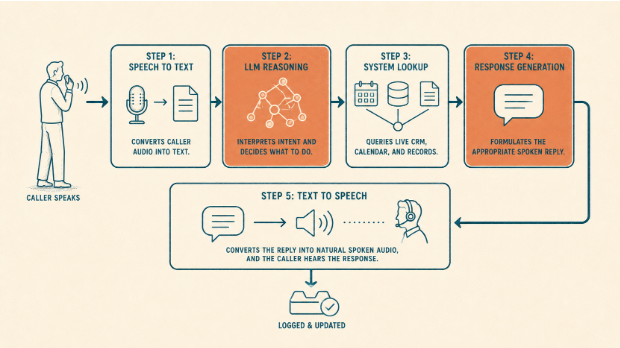
Every AI voice agent runs the same core loop, regardless of the platform or vendor. Understanding each step is what separates buyers who get a working deployment from those who get a sophisticated demo that fails in production.
Part 1: Speech recognition (ASR) and Speech-To-Text (STT) converts the caller's voice to text
Automatic Speech Recognition and STT systems listens to the live call audio and transcribes it in real time. Modern ASR handles a wide range of accents, background noise, cross-talk, and mid-sentence interruptions; all of which will happen in real calls. The quality of the ASR layer is often what separates a frustrating experience from a smooth one, and it's frequently underweighted in vendor evaluations.
Part 2: The LLM understands intent and decides what to do
The transcribed text goes to a language model that interprets what the caller actually wants. This isn't keyword matching. It's intent understanding that includes follow-up questions, topic changes mid-call, implied requests, and context from earlier in the conversation. A caller asking "can I move that?" after discussing an appointment doesn't need to repeat themselves; the LLM carries context forward.
Part 3: The agent pulls live data from your systems
A properly built voice agent doesn't guess or give generic answers. It queries your CRM, order management system, appointment calendar, or knowledge base in real time so the answer it gives is specific to that caller's account, that product, that booking, that policy. This integration layer is where most of the real engineering work lives, and skipping it produces agents that sound good but can't actually do anything useful.
Part 4: Text-to-speech turns the response into natural voice
The agent's text reply is converted back to audio using modern neural voice synthesis. The gap between 2020-era robotic TTS and 2026-era voice synthesis is large enough that most callers interacting with well-built agents don't realize they're talking to software. This is not a small thing - the moment a voice sounds mechanical, caller trust collapses.
Part 5: The agent writes the outcome back to your systems
When the call ends, the agent doesn't just hang up. It updates the CRM record, confirms the booking, logs the support ticket, or fires the next workflow step automatically, with no manual data entry. This is what transforms a voice agent from a fancy answering service into actual business infrastructure.
A note on latency: the entire ASR to LLM to TTS loop has to complete in under approximately 800 milliseconds to feel like a natural conversation. That is a real engineering constraint. Any vendor who hasn't solved it will produce an agent with conversational pauses long enough to make callers hang up. It's one of the quieter signals of whether a team has actually built and run production voice agents.
8 ways businesses are using AI voice agents right now
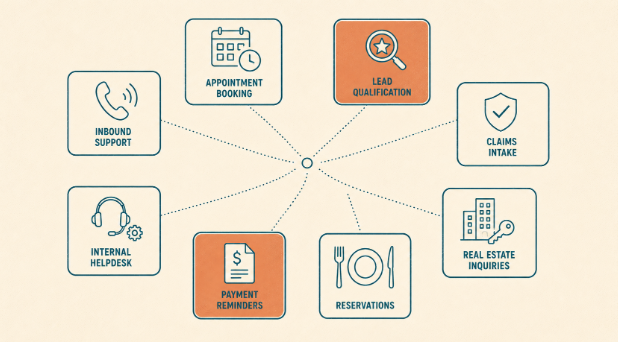
Inbound customer support
AI voice agents handle tier-1 support calls like order status, account questions, password resets, basic troubleshooting - without hold times or staffing constraints. Well-implemented deployments have shown AI agents managing upward of 77% of L1 to L2 support volume, freeing human agents for the calls that actually require judgment. The economics of AI call center automation shift dramatically when routine call volume stops hitting your headcount.
Appointment booking and scheduling
Clinics, salons, real estate agencies, law firms, and home services businesses all share the same problem: the phone rings during patient care, with a client, or after hours, and whoever answers is pulled away from billable work. Voice agents answer, check live calendar availability, book the slot, send the confirmation, and log everything including at 11 PM on a Saturday.
Lead qualification and sales calls
Voice AI for sales operates both inbound and outbound. Inbound: a prospect fills out a form, the agent calls within 60 seconds, asks qualifying questions, scores the lead, and either books a meeting or politely disqualifies. Outbound: the agent works through a cold or warm list at scale, identifies interested parties, and routes only real prospects to a human rep. Sales teams that deploy this correctly stop spending 60% of their time on calls that go nowhere.
Insurance claims intake
First notice of loss calls follow a predictable structure; incident date, policy number, type of claim, basic damage description. That structure makes them ideal for voice automation. The agent handles the intake accurately, captures required information completely, and logs it directly into the claims system, reducing human error and processing time simultaneously.
Real estate inquiry handling
This use case is particularly strong for UAE and Saudi markets, where real estate firms field enormous call volumes for property inquiries in both Arabic and English often outside UK and US business hours. A voice agent handles the first-touch conversation 24/7: asking about budget, timeline, preferred location, property type, and desired features, then either scheduling a site visit with a human agent or passing a qualified lead summary directly into the CRM. For developers launching new projects, this alone can process hundreds of inquiry calls in the first days of a campaign without adding headcount.
Restaurant and hospitality reservations
Phone-based reservation booking without a host tied to the line. The agent handles party size, preferred time, dietary requirements, special occasion notes, and sends a confirmation logged automatically into the reservation system. The same agent handles cancellations and modifications. For high-volume restaurants, this frees front-of-house staff for the guests already in the room.
Debt collection and payment reminders
Outbound payment reminder calls are repetitive, emotionally demanding for human staff, and highly sensitive to scheduling. Voice agents handle compliant, consistent outbound calls including required disclosures, multiple contact attempts, and outcome logging removing the emotional burden from collections staff while maintaining the consistency that compliance requires. Jurisdiction-specific rules apply; this use case needs legal review baked into the build.
Internal helpdesk by phone
Employees calling IT or HR with routine questions like how to reset a VPN credential, what the PTO policy is, how to submit an expense etc. are a high-volume internal drain that rarely gets optimized. A voice agent connected to your internal knowledge base handles these instantly, any time, without a ticket queue. Underused and genuinely high-value, especially for companies with distributed or shift-based workforces.
The real numbers: cost, ROI, and what's actually happening in 2026
The business case for voice AI is no longer theoretical. The numbers have been measured at production scale across enough organizations that the ranges are now fairly reliable.
Per-call cost comparison: an AI phone call agent handles a typical inbound support or booking call at approximately $0.40 in infrastructure costs i.e ASR, LLM inference, TTS, and telephony combined. A human-handled equivalent call costs between $7 and $12 when fully loaded with labor, overhead, and management. That's a 90 to 95 percent reduction per interaction.
| Metric | Human Agent | AI Voice Agent |
|---|---|---|
| Cost per call (fully loaded | $7–$12 | ~$0.40 |
| Availability | Business hours only | 24/7/365 |
| Scales with volume | Requires hiring | Instantly |
| 3-year ROI (Forrester) | N/A | 331%–391% |
| Typical payback period | N/A | Under 6 months |
A Forrester Consulting study of voice AI deployments found that the three-year return on investment ranged between 331 and 391 percent across the organizations studied. One composite enterprise in that analysis saved over $10 million in agent labor costs across three years while also cutting call abandonment rates significantly, suggesting that the cost savings didn't come at the expense of caller experience.
A 2026 Gartner survey found that 91 percent of customer service leaders are now under direct executive pressure to implement AI meaning the question in most organizations has shifted from "should we?" to "how do we do this without it blowing up." Gartner projects that conversational AI will reduce contact center labor costs by tens of billions of dollars in 2026 alone. McKinsey's research adds an important nuance: AI-enabled service can raise customer satisfaction and operational efficiency, simultaneously challenging the old assumption that cutting costs inevitably means cutting quality.
The resistance to voice AI today is almost never about the underlying economics. It's about implementation quality and that's a solvable problem.
Human-in-the-loop vs. fully autonomous: which model fits your business?
Fully autonomous deployments handle calls without any human involvement. The agent manages the interaction from the first ring to the logged outcome. Human-in-the-loop deployments use the AI to assist, triage, or gather context, then route to a human for the decision or conclusion.
Fully autonomous fits when:
- Call volume is high and the task is structurally predictable (appointment booking, order status, FAQ responses)
- The cost of an occasional imperfect answer is low and recoverable
- You need 24/7 coverage without staffing overnight or weekend shifts
- Speed of response matters more than personalization
Human-in-the-loop fits when:
The interaction involves nuanced or high-stakes judgment like a patient describing complex symptoms, a customer disputing a significant charge, a claimant describing an accident. It also applies wherever compliance exposure is real: healthcare, financial services, and insurance all have regulations that touch voice interactions, and in those contexts removing human judgment entirely creates legal risk that most organizations aren't ready to carry. The agent's job in these deployments is to gather context, triage severity, and route with a clean call summary so the human starts informed rather than starting from zero.
Most businesses start with a hybrid model. The AI handles the predictable 70 to 80% of calls completely, and routes the remaining 20 to 30% to a human with full context already gathered. This is almost always the right starting point for a first deployment. It delivers most of the cost savings immediately, while keeping human judgment available for the edge cases that matter.
What can go wrong and how to avoid it
Most voice AI deployments that fail don't fail because the technology doesn't work. They fail because the implementation was under-specified, under-tested, or under-escalated.
The most common failure modes:
- Poor workflow design: callers trapped in loops, unable to get what they need, hanging up more frustrated than when they called. This is a design problem, not a technology problem.
- Missing escalation paths: the agent hits the edge of what it can handle and has no graceful way out. Instead of transferring, it loops. This is the single most common cause of bad customer experiences in voice AI.
- Inaccurate intent detection on non-standard speech: accents, background noise, hesitation speech ("uh, I want to… actually, can I also check…"), and domain-specific terminology all create failure points that scripted demos never surface.
- Compliance exposure in regulated industries: recording disclosures, consent requirements, calling hours, and prohibited language vary by jurisdiction and can create serious legal exposure when built in as an afterthought.
What actually works:
- Start with a narrow, well-defined call type: Don't try to automate every call type on day one. Pick the highest-volume, most structured use case and build that properly first.
- Build escalation paths before anything else: The agent should know when it's out of its depth and hand it off gracefully - with the call summary already written - before a caller gets frustrated.
- Test with real call recordings, not demo scripts: Accents, interruptions, and background noise are where voice agents actually break. If the only testing that happened was against scripted scenarios, the deployment will fail in week one.
- Keep a human reviewing transcripts in the first 2 to 4 weeks: Issues compound fast. Catching a systemic misinterpretation early, before it runs through thousands of calls, is worth the review time.
What does an AI voice agent cost to build?
Costs vary by call complexity, integration depth, and the volume the agent needs to handle. The ranges below reflect custom builds, not SaaS platform subscriptions.
| Scope | Typical build cost | Notes |
|---|---|---|
| Single use-case agent (e.g., appointment booking) | $15K–$40K | One CRM integration, defined call flow, single language |
| Multi-use-case agent (support + booking + FAQs) | $40K–$100K | Multiple integrations, escalation logic, broader call handling |
| Enterprise contact center deployment | $100K–$400K+ | Full CRM/telephony integration, compliance requirements, multi-language |
Ongoing costs include per-call usage fees for ASR, LLM inference, and TTS plus telephony infrastructure and monitoring. At approximately $0.40 per automated call versus $7 to $12 per human-handled call, most deployments recover the build cost within a few months once call volume is meaningful.
For a full breakdown of what drives AI agent development costs across all agent types, see How much does it cost to build an AI agent in 2026? - including the variables that move a project from $15K to $400K.
How to choose between buying a voice AI platform vs. building a custom one
Off-the-shelf platforms like Vapi, Bland, Retell, and a growing number of vertical-specific tools are the fastest path to a working proof of concept. For validating a use case before committing a significant budget, starting on a platform is almost always right. The limitations emerge when you need custom call logic that doesn't fit the platform's flow builder, when you need deep integrations with internal systems that aren't pre-supported, or when data residency and ownership matter which is increasingly the case in regulated industries and Middle East enterprise deployments.
Custom-built voice agents take longer to ship, typically 6–14 weeks depending on scope, but give you complete control over call flow design, data handling, integration depth, and the ability to tune the agent's behavior to your exact business context. Once you're past the pilot stage and scaling to real volume, the inflexibility of off-the-shelf platforms tends to become more expensive than the cost of a production AI backend built to your spec.
The pattern that works in practice: pilot on a platform to prove the use case in 2 to 4 weeks. Once you know exactly what the agent needs to do and what the edge cases are, move to a custom build. The platform pilot tells you what to build; the custom build tells you what you'll actually run at scale.
Getting started: what to scope before you talk to a development team
The projects that move fastest are the ones where the business has already done the internal thinking before the first conversation with a developer. Five questions worth answering before that call:
1. Which single call type costs you the most time or money right now? Start there. Not "automate everything". One well-chosen use case that delivers clear ROI and builds organizational trust in the technology.
2. What systems does the agent need to read from and write to? CRM, booking calendar, ticketing system, order database. The integration map determines 60% of the build complexity.
3. What's your current call volume for that use case? This number determines ROI, payback timeline, and whether the economics justify a custom build or a platform pilot.
4. What's your escalation policy? When should the AI hand it off to a human? To whom? What happens outside business hours? These questions need answers before the first line of code is written.
5. Does this involve a regulated process? Financial, medical, and legal contexts have compliance requirements like recording consent, required disclosures, data handling etc. That shapes the build from day one, not as an afterthought.
Conclusion
AI voice agents crossed from experimental to production infrastructure faster than almost any other category of applied AI. The economics are proven, the technology has caught up, and the businesses moving now are capturing a real cost and speed advantage. The deployments that succeed share one trait: they start narrow, build proper escalation paths, and expand only once the first use case is genuinely solid.
Frequently Asked Questions
1. Can AI voice agents really hold a natural conversation?
Modern AI voice agents handle open-ended conversation well for well-scoped tasks — booking, support, lead qualification — using real-time speech recognition and neural voice synthesis that is meaningfully close to human-sounding. They're not indistinguishable from a person in every scenario, and a well-designed deployment doesn't try to be. For structured call types with clear objectives, most callers complete the interaction without it affecting their satisfaction — and many don't register that it's automated at all.
2. Will customers be upset talking to an AI instead of a human?
Research from Zendesk found that over half of consumers actually prefer automated interactions when they want immediate service — because speed matters more than who answers when the task is routine. The stronger predictor of dissatisfaction isn't whether the agent is AI or human; it's whether the experience is well-designed. An AI agent with clear escalation paths and fast resolution is consistently rated better than a human agent with long hold times and inconsistent answers.
3. What languages can AI voice agents handle?
Most modern voice AI platforms support major languages including English, Arabic, French, and Spanish, though quality varies significantly between providers and across regional dialects. For Middle East deployments specifically — Gulf Arabic versus Levantine Arabic versus Modern Standard Arabic — dialect handling is a real differentiator and must be tested against actual caller samples before go-live. Generic Arabic language models often underperform significantly on regional speech patterns, and this is not something a vendor demo will reveal.
4. How long does it take to deploy an AI voice agent?
A single, well-defined use case such as appointment booking or inbound FAQ handling can go from kickoff to live calls in 3–6 weeks when the call flow is clear and system integrations are documented in advance. Multi-use-case deployments with several system integrations, escalation logic, and compliance requirements typically take 8–14 weeks. Timeline variance is almost always driven by integration complexity and access to real call recordings for testing, not the voice AI build itself.
5. Do AI voice agents work for outbound calls, or just inbound?
Both. Inbound use cases include customer support, appointment booking, and general inquiry handling. Outbound use cases include lead qualification calls, payment reminders, appointment confirmations, and post-service follow-up. Outbound deployments require additional attention to compliance: calling hour restrictions, consent requirements, required disclosures, and do-not-call list management all vary by jurisdiction and need to be built in from day one, not added retroactively.
6. What happens when the AI voice agent doesn't know the answer?
A properly built agent recognizes the boundaries of its reliable knowledge and escalates — transferring to a human agent with a complete summary of the call so far, or scheduling a callback. The caller doesn't have to repeat themselves; the human picks up with full context. This escalation logic is one of the most important parts of any voice agent build. Skipping it — or building it poorly — is the single most common cause of bad customer experiences in voice AI deployments.