What is an AI agent and how does it work for businesses in 2026
AI agents are autonomous software that perceive, reason, and act to automate workflows and operations with minimal human input.

What is an AI agent?
To put it simply, an AI agent is software that perceives its environment, reasons about what to do, and takes action autonomously without a human directing every step. Unlike a chatbot that only responds to questions, an AI agent can use tools, browse the web, write code, call APIs, and complete multi-step tasks on its own. In 2026, businesses are predicted to use AI agents more to automate monotonous tasks like customer calls, qualify leads, process documents, manage workflows, and run operations at a fraction of the cost of a human team.
Your competitors aren't hiring faster. They're automating smarter.
AI agents are software that perceives, reasons, and acts without waiting for a human to approve every step. Not a chatbot. Not a workflow tool. Something that actually gets things done.
They don't just respond. They perform. They execute. And the businesses that understand the difference are pulling ahead. Fast.
With technology moving this quickly, the question isn't what an AI agent is. It's whether your business is even ready for one.
The one-line definition and why it matters
Let’s start with the basics first.
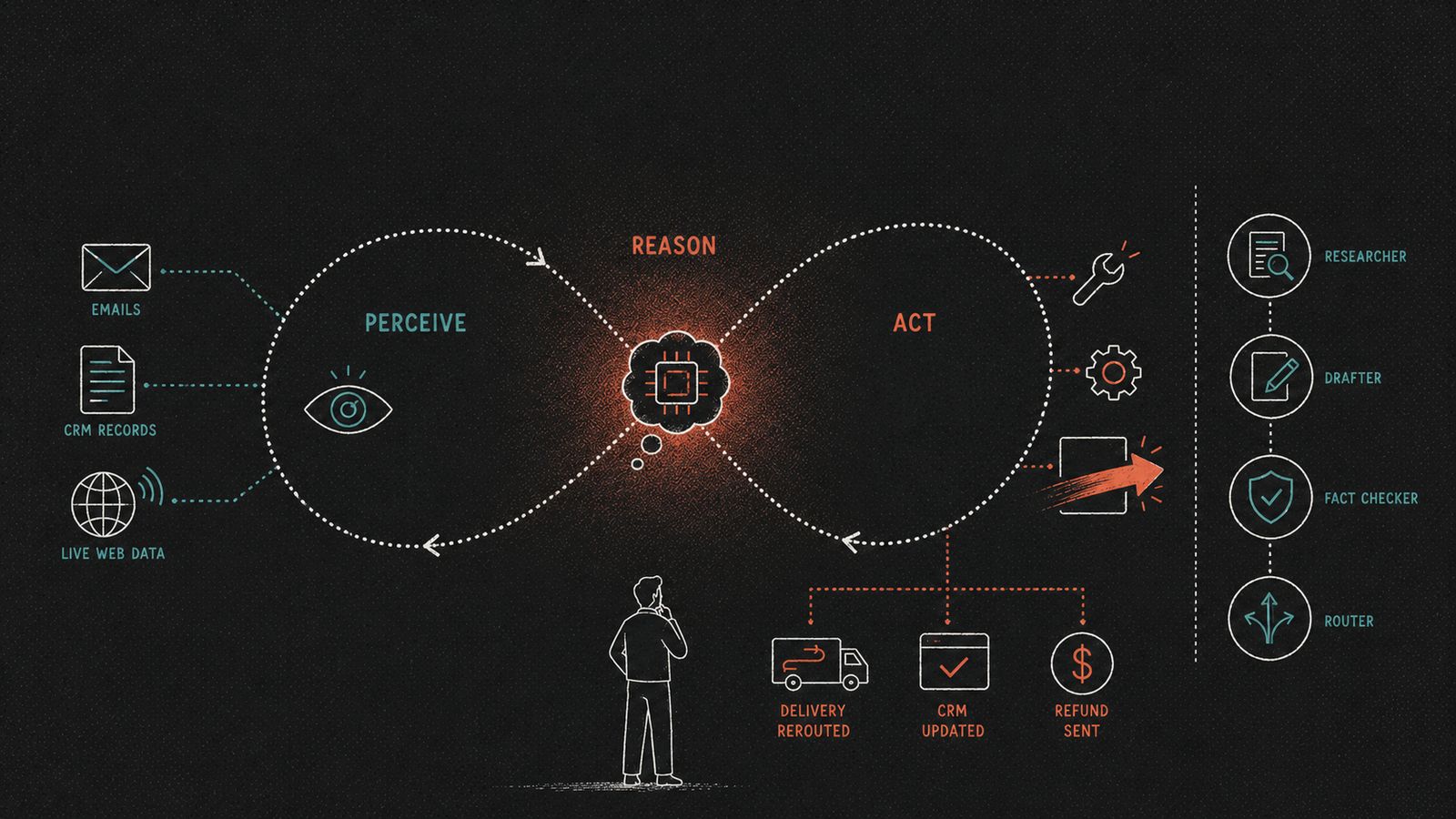
An AI agent operates on a perceive, reason and act loop.
It takes in information from its environment, decides what to do with it, and then does it repeatedly, without being re-prompted for every step.
The word "agent" is deliberate. It comes from the concept of autonomous agency - the capacity to act on one's own behalf toward a goal. That's what separates an AI agent from a language model sitting in a chat box. A language model responds. An agent acts.
The most useful analogy that can help you understand is that an AI agent is like a new hire who understands their job description and has access to every tool in the building. You give them an objective. They figure out how to accomplish it, without you holding their hand through each task.
If you're wondering whether your business needs one, the answer is in the next section.
AI agent vs chatbot: what's the actual difference?
A chatbot responds to questions. An AI agent takes action in the world. That's the whole distinction and it matters ENORMOUSLY when you're deciding what to build.
| Chatbot | AI Agent | |
|---|---|---|
| Responds to questions | Yes | Yes |
| Takes action in external systems | No | Yes |
| Completes multi-step tasks | No | Yes |
| Remembers context across sessions | Limited | Yes |
| Works without human input mid-task | No | Yes |
Consider a concrete example.
A chatbot tells a customer: "Your order is delayed." However, An AI agent detects the delay, reroutes the shipment, updates the CRM record, and sends the customer a refund without anyone asking it to do any of those things individually.
Same data. Completely different outcome.
This distinction explains why most "AI chatbot" projects disappoint the businesses that fund them. They're the wrong tool for the job. A chatbot answers. An agent resolves.
How does an AI agent actually work? (5-step breakdown)
AI agents follow a structured process every time they act. Understanding this loop is what separates a buyer who deploys agents that work from one who funds demos that never survive production.
Step 1: It receives a goal, not a script
The agent is given an objective, not a rigid decision tree. Traditional automation breaks the moment something unexpected happens. An AI agent treats unexpected inputs as part of the problem to solve, not a system error to throw.
Step 2: It perceives its environment
The agent reads its inputs: emails, CRM records, database entries, live web data, uploaded documents, API responses. This collection of available information is what the agent uses to understand the current state of the world. In technical terms, everything it can "see" at one moment lives in its context window; the active working memory of the underlying language model.
Step 3: It reasons using an LLM
The language model is the brain. It takes in the context and decides what action to take next. This is where model quality - GPT-4o, Claude, Gemini - and the engineering behind the prompts determine how reliable the agent is in production. A well-prompted agent with a capable model makes decisions that hold up. A poorly engineered one hallucinates a path forward and fails silently.
Step 4: It uses tools to take action
Tools are what separate an LLM agent from a language model alone. A tool is any capability the agent can invoke: web search, code execution, calendar booking, CRM writes, email dispatch, API calls. Each tool call is a discrete action the agent chooses to make based on its reasoning. The richer the tool set, the wider the range of tasks the agent can complete autonomously.
Step 5: It loops, checks, and corrects
After each action, the agent re-evaluates: Did that work? What's next? Does the outcome match the goal? This planning loop is what makes agentic systems genuinely useful and genuinely risky if not built correctly. Production agents include guardrails that define what the agent can and cannot do, evals that measure whether its outputs are accurate, and escalation paths for when it hits the edge of its confidence. A demo agent loops elegantly. A production-grade agent loops safely.
6 real ways businesses are using AI agents right now
These aren't hypotheticals. Each use case below is live in some form across industries in the US, UK, and Middle East as of 2026. According to the Stanford 2025 AI Index, agentic AI job postings grew 280% year-over-year which tells you something about where enterprise investment is actually going.
1. AI voice agents for sales and customer support
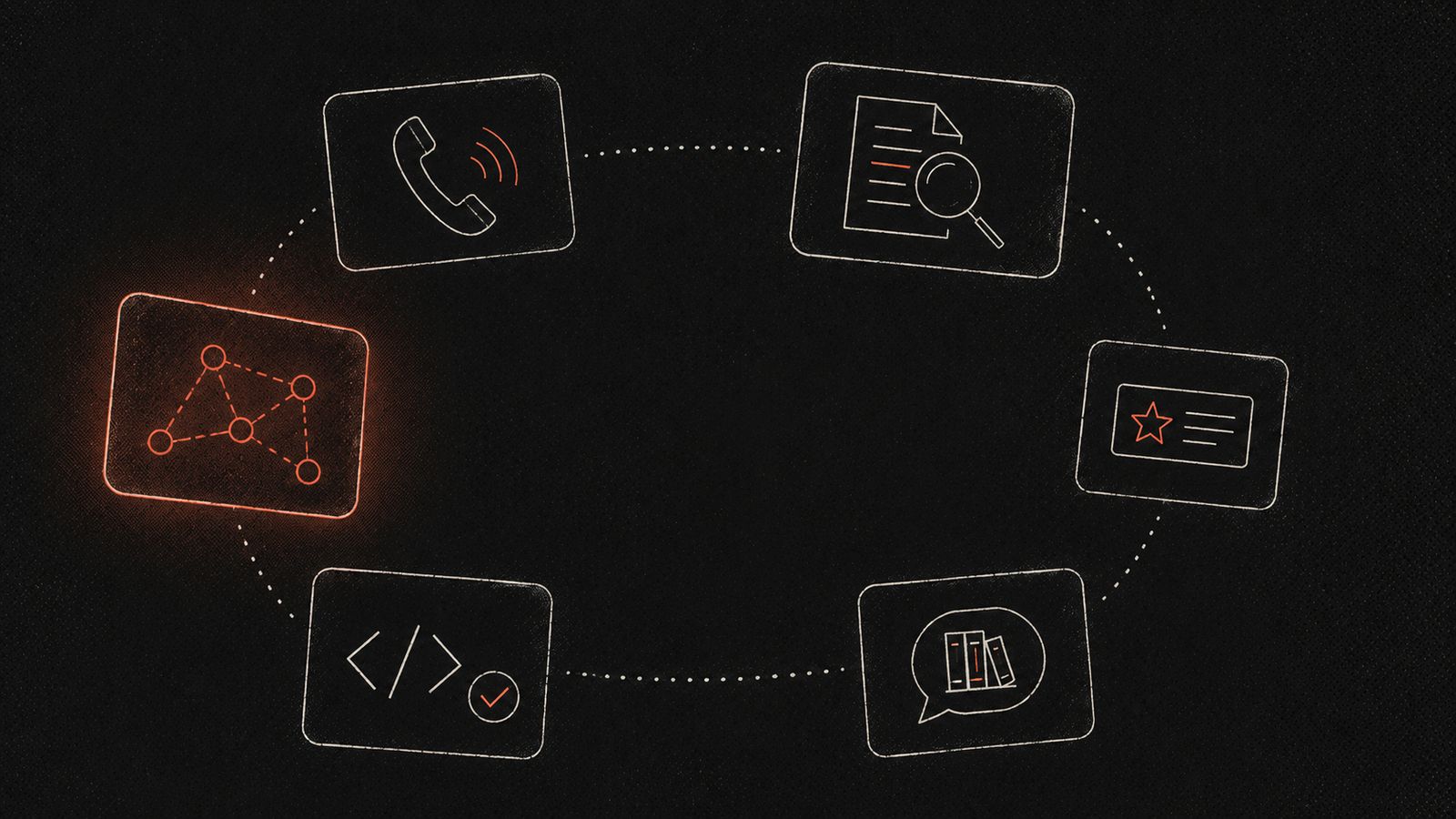
Businesses are replacing and augmenting call center operations with AI voice agents that handle inbound calls, qualify leads, answer product questions, and book meetings around the clock. In the UAE, real estate firms are deploying voice agents that handle inquiry calls in both Arabic and English, qualifying buyers before a human agent ever picks up the phone. The economics are difficult to ignore: a voice agent handles hundreds of simultaneous calls at a fixed infrastructure cost.
2. Document processing and extraction
Legal, finance, and insurance firms use document-processing agents to read contracts, extract key clauses, flag anomalies, and populate databases. A task that used to take a junior analyst two to four hours per document now takes seconds. The agent doesn't just extract. Iit reasons about what it finds, flagging clauses that deviate from standard terms or that require escalation.
3. Lead qualification and CRM enrichment
When a new lead enters the pipeline, an AI agent can research the company, score fit against ICP criteria, draft a personalized first outreach email, and log everything to the CRM before a human sales rep even sees the name. The rep arrives at a conversation that's already been qualified and contextualized, not a cold list to work through manually.
4. Internal knowledge assistants (RAG-powered)
Companies build internal AI agents that answer employee questions using company documentation, past support tickets, HR policies, and product specs. Retrieval-augmented systems that pull from verified sources before generating a response. Unlike a general-purpose chatbot, they never hallucinate a policy they haven't read. What they know is bound by what they've been given.
5. Code review and developer tooling
Engineering teams deploy agents that review pull requests, flag security vulnerabilities, suggest code improvements, and write test cases. Code review cycles that previously took two to three days compress to hours. The agent doesn't replace the senior engineer's judgment; it removes the repetitive, low-judgment parts of the review process so that engineers’ attention goes where it actually matters.
6. Multi-agent workflows for complex operations
The most powerful deployment pattern isn't one agent — it's several working together. One agent researches a topic. A second drafts a response. A third fact-checks it. A fourth formats and routes the output. This multi-agent orchestration is what media companies, financial services firms, and research organizations are building to compress complex knowledge work that currently spans teams and days. It's the autonomous AI architecture that scales.
What does an AI agent cost to build?
Cost varies significantly with scope and complexity. Here's a realistic breakdown:
| Agent Type | Typical Build Cost | What's Included |
|---|---|---|
| Simple, single-purpose agent | $5,000 – $30,000 | One workflow, limited integrations, basic guardrails |
| Production-grade agent with integrations | $50,000 – $100,000 | CRM/API connections, memory, evals, monitoring |
| Multi-agent orchestration system | $100,000 – $400,000+ | Multiple specialized agents, orchestration layer, full observability stack |
Build cost is only part of the picture. Ongoing LLM API costs, monitoring infrastructure, and the engineering time required to run evals and manage prompt drift over time are real budget line items. An agent that costs $60,000 to build can cost $15,000–$40,000 per year to operate properly at scale.
For the full breakdown of what drives these numbers, see how much does it cost to build an AI agent in 2026?
When does a business actually need an AI agent?
Not every problem needs an AI agent. Knowing when to build one - and when not to - is the most valuable judgment call in this space.
You need an AI agent when:
- The task has too many decision branches for a rigid script to handle
- You need the system to take actions in external tools, not just respond with text
- The volume is too high for a human team to handle cost-effectively
- The task requires reasoning across multiple data sources simultaneously
- Speed matters; the response needs to happen in seconds, not minutes
You probably don't need a full AI agent when:
- The task is simple and predictable (a workflow tool like Zapier or n8n handles this at a fraction of the cost)
- You're in early validation and don't yet have clean, documented processes
- Your core operations aren't documented - agents amplify what exists, they don't invent structure from nothing
That last point deserves emphasis. An AI agent that automates a chaotic, undocumented process doesn't fix the chaos. It accelerates it. The businesses getting the most out of agents are the ones that had clear processes to begin with.
What to look for in an AI agent development partner
Not every AI development shop builds agents that hold up under real production traffic. The right questions to ask before you sign: Do they build evals and guardrails into the scope, or are those optional add-ons? How do they handle prompt drift when model providers update their APIs? Can they show you a system running in production - not a polished demo built for a pitch?
The difference between a functioning demo and a reliable production system is significant. It's the difference between an agent that works in a controlled environment and one that handles your actual customers, your actual edge cases, and your actual data.
We build AI agents that survive production - not just demos
Tell us what you're trying to automate. Start a conversation
Conclusion
AI agents are the most consequential technology shift for business operations since the smartphone and the gap between a demo agent and a production-grade one is enormous, and growing. The businesses building the right foundations now will compound that advantage for years.
Frequently Asked Questions:
1) What's the difference between an AI agent and agentic AI?
An AI agent is a single autonomous system built for a specific purpose - qualifying leads, processing documents, handling support calls. Agentic AI is the broader concept: a system or set of systems that operates with genuine agency, often involving multiple agents working together toward a shared goal. Think of it this way - AI agent is one employee; agentic AI is the autonomous team.
2) Do AI agents replace human employees?
Not typically. They replace specific tasks, not entire roles. Most businesses use AI agents to handle high-volume, repetitive, or time-sensitive tasks - freeing humans to focus on relationships, judgment calls, and work that genuinely requires human context. The displacement pattern in practice is task-level, not role-level.
3) How long does it take to build an AI agent?
A simple, focused agent can be built and deployed in 2 to 4 weeks. A production-grade agent with integrations, guardrails, memory, and evals typically takes 6 to 12 weeks, depending on the complexity of the systems it connects to and how much process documentation already exists on the client side.
4) Can AI agents make mistakes?
Yes. This is the most important thing to understand before you commission a build. Without evals, guardrails, and fallback logic, agents fail silently in ways that damage customer trust and create operational liability. Production-ready AI agents include monitoring, cost controls, confidence thresholds, and escalation paths for when the agent hits the edge of what it reliably knows. The gap between a demo agent and a production agent is precisely here.
5) What AI models power AI agents?
The most common underlying models are OpenAI's GPT-4o, Anthropic's Claude, and Google's Gemini. The model is one component - important, but not the whole story. The architecture surrounding it (memory design, tool selection, orchestration logic, guardrails, and evals) determines how well the agent actually performs under real traffic and real edge cases.
6) How do I get started with AI agents for my business?
Start by identifying one high-volume, repetitive task that currently costs your team significant time or money. Define what success looks like in concrete terms - speed, accuracy, cost reduction. Then work with a development team to prototype a single-purpose agent before scaling to multi-agent workflows. The businesses that fail with agents are usually the ones that tried to automate everything at once before they proved out one thing that works.