How to Hire an AI Development Agency: 9 Key Questions
Most AI agencies can build a demo. Few can ship something that survives production. Here are 9 questions that reveal which type you're talking to.
How do you hire the right AI development agency?
Ask nine specific questions before signing anything: how they handle production failures, what their pricing model actually covers, whether they include evals and guardrails by default, and whether they can show a live system; not just a demo. Most AI agencies can build something that works in a sales call. Few can build something that keeps working once real users, real data, and real edge cases hit it. The questions below separate agencies with genuine production experience from those repackaging tutorials as expertise.
Every agency website says "AI-powered" now. A 45-minute sales call won't tell you whether that means a senior team with production deployments behind them or a team that learned to wrap an API last year and called it a product. The gap isn't visible until months after you've signed when real traffic, real edge cases, and real data hit the system and you find out what you actually bought. Knowing how to hire an AI development agency properly means asking questions designed to surface that gap before the contract is signed, not after. This guide gives you nine of those questions, the red flags that should make you walk away, and the step-by-step process to run the evaluation correctly.
Why this is harder to vet than normal software hiring
The AI development market is genuinely difficult to evaluate from the outside.
The category exploded between 2023 and 2025 with global AI spending on track to exceed $2 trillion in 2026, according to IDC's Worldwide Artificial Intelligence Spending Guide, and agencies multiplied to match that demand. Many of those agencies were built by teams that learned to use AI tools without ever having shipped production software at meaningful scale.
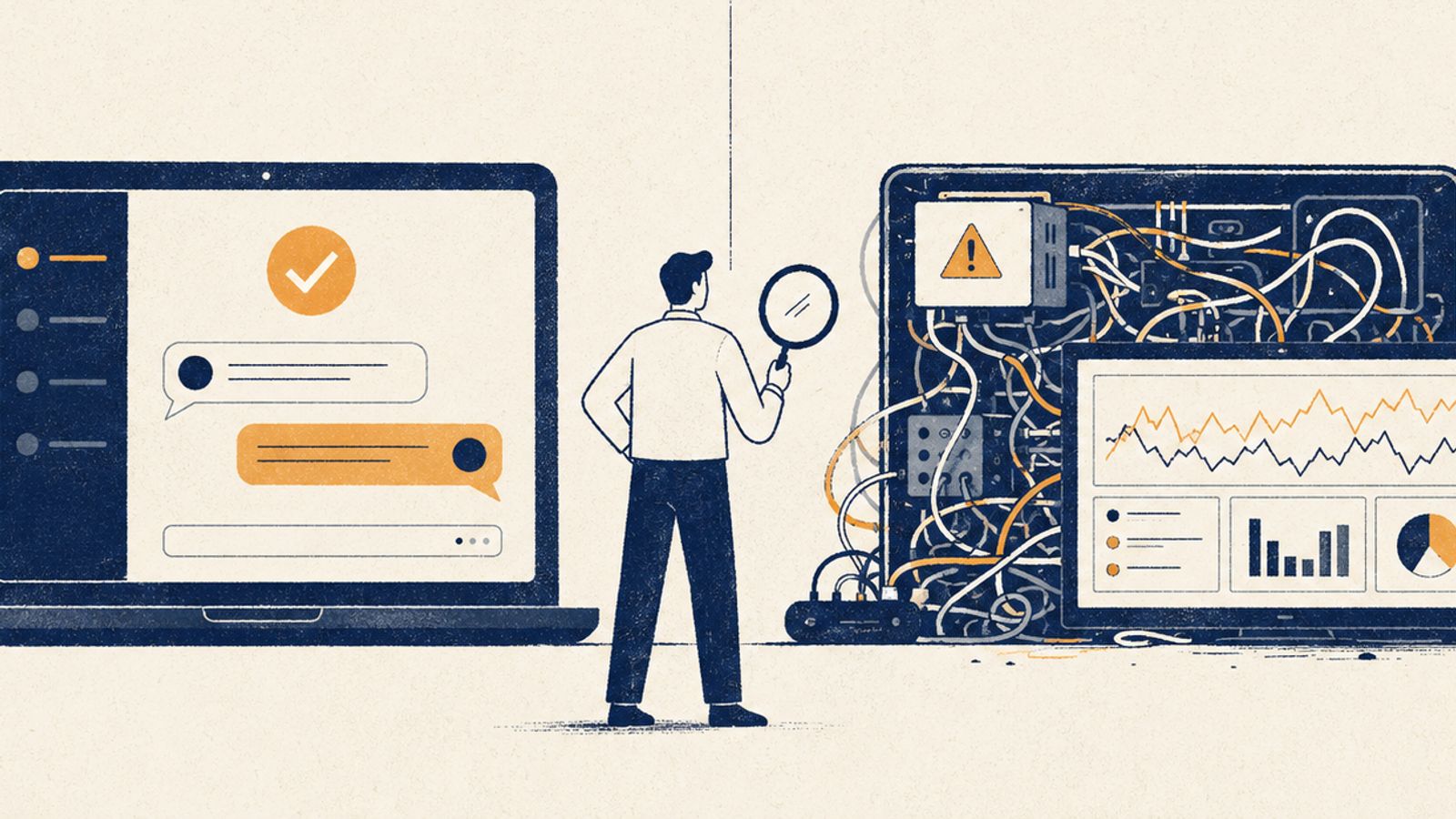
The skill gap is invisible in a demo. A chatbot wrapping an LLM API looks identical to a production-grade agent in a 15-minute call. Same smooth responses, same impressive answers to scripted questions, same confident language about scalability. The differences only surface months later, when the agent hallucinates under unusual input or when your agent is used to answer “What colour is the sky” is when LLM API costs spike unpredictably under real usage, or when the system silently degrades and nobody notices for weeks because there's no monitoring.
This is why question quality matters more than portfolio quantity. A long case study page tells you almost nothing about whether a team can handle what happens after launch. Specific, production-focused questions do. For a broader grounding in what AI agents actually are before you start this process, that's a useful starting point.
The 9 questions to ask before you sign anything
These questions work because they require specific knowledge to answer well. Agencies with genuine production experience will answer them in detail, often with concrete examples. Agencies without that experience will deflect, generalize, or get defensive. Both responses are useful information.
1. "Walk me through an AI system you built that broke in production. What happened?"
Why it matters: Every real production system has failed at some point. The question isn't whether failures happen - they do - it's how the team identified the problem, communicated it, and fixed it. A team with genuine production depth will have a specific story ready: what broke, how they detected it, what they changed to prevent recurrence.
Good answer: Names a specific system, describes a specific failure mode (hallucination under an edge case input, a tool call returning malformed data, latency spiking under load), explains what monitoring caught it - or honestly admits they caught it too late - and describes what they changed afterward.
Bad answer: "Our systems don't really break" or a vague, generalized answer with no specifics. This almost always means either the team hasn't shipped much in production, or they're not being straight with you.
2. "What happens when a tool call fails mid-task, or the model returns something unexpected?"
Why it matters: This question cuts directly to whether the team has built real fallback logic or whether their systems run on optimistic assumptions. Production AI systems encounter unexpected inputs constantly. The question is whether the architecture handles this gracefully or falls over.
Good answer: Describes specific retry logic, explains how errors are caught and classified, walks through what the user experience looks like when something fails (a graceful degradation or a clear error state, not a broken loop), and explains how failures are logged for review.
Bad answer: Confusion about the question, or claims the model "never returns unexpected results." Anyone who says this hasn't shipped to real users.
3. "Do evals and guardrails come standard, or are they an add-on?"
Why it matters: This is the single clearest signal of whether you're buying a demo-grade build or a production-grade one. Evals - systematic tests that measure whether the AI is behaving correctly - and guardrails - mechanisms that catch and handle unsafe or out-of-scope outputs - are not optional extras in a well-run AI build. They're core infrastructure. Teams that treat them as optional almost always drop them when scope tightens.
Good answer: Evals and guardrails are described as default scope on every engagement, with a concrete explanation of what gets tested, how often, and what guardrail categories are included for the specific use case.
Bad answer: "We can add that if you need it" or "we test it manually before launch." This is not the same thing, and the distinction matters enormously once the system is handling thousands of real interactions.
4. "How do you keep AI running costs predictable once we're live?"
Why it matters: LLM API costs are usage-based and can spike significantly under real traffic - especially if prompts are poorly optimized, if the model selection wasn't made with cost in mind, or if there's no monitoring catching runaway usage. Teams without production experience often haven't thought past the demo, where cost is negligible.
Good answer: Discusses prompt versioning and optimization, token usage monitoring, model tier selection trade-offs (which calls go to a smaller, faster model versus a full frontier model), and cost alerting or ceiling mechanisms. Ideally, mentions having navigated a real cost spike and what they did about it.
Bad answer: They haven't thought about this, treat it as unimportant, or offer a vague reassurance without any specifics.
5. "Can you show me a live system, not a demo recording?"
Why it matters: Demo recordings are curated. They show the path that worked, not the edge cases that didn't. A live system, even a screen share of a working client product with appropriate permission, or a live walkthrough of an internal prototype, is much harder to stage.
Good answer: Willingness to show a live, working system for at least one relevant project, or a detailed architecture walkthrough that demonstrates specific technical depth like memory design decisions, retrieval strategy, how the integration layer handles errors.
Bad answer: Every conversation ends up back at the same polished demo video, or the agency gets visibly defensive about the request. If a team can't show you a live system after months of "AI development," that's a meaningful data point.
6. "What's your pricing model, and what's NOT included?"
Why it matters: Vague proposals produce vague outcomes and scope disputes later. The most important part of a proposal is often what's explicitly excluded; evals, monitoring setup, post-launch support, infrastructure costs, revision cycles after the first review. Understanding the explicit boundaries of what you're buying tells you more than the headline number.
Good answer: Phase-by-phase pricing with specific deliverables per phase, clear statements about what triggers additional cost, and explicit answers about what's out of scope. In writing.
Bad answer: A single lump number for "the whole project" with no breakdown, or reluctance to define what's out of scope. This is where scope disputes start.
7. "Who exactly will be working on our project, and what's their background?"
Why it matters: Agencies often present senior talent in the pitch and staff the actual work with more junior team members. You want to know, by name and role, who's doing the build, not who's doing the sales call. Then you can ask those specific people technical questions.
Good answer: Specific names, specific roles, specific past projects that are directly relevant to your use case and a clear statement of how much of their time is allocated to your project versus others running in parallel.
Bad answer: Vague references to "our team" or "our engineers" with no specifics. This is the tell that you'll get whoever's available, not the team you deserve.
8. "Can you walk through the architecture of a past project in technical detail?"
Why it matters: Real builders can go deep. How they designed the memory layer, why they chose a particular retrieval strategy, what the integration points between the AI and the backend systems look like, how they handle context window limits at scale. If you have an engineer on your team, bring them to this call. Pitch-deck sellers stay at the surface level no matter how many follow-up questions you ask.
Good answer: Specific technical decisions explained with reasoning - why they chose retrieval-augmented generation over fine-tuning for a particular use case, how the agent's state is persisted between calls, what the fallback looks like when the vector search returns poor results. Comfortable handling pushback and follow-up.
Bad answer: Redirects to outcomes and buzzwords ("our AI drove a 40% improvement in efficiency") every time the conversation gets technical. Outcomes matter, but a team that can only talk about outcomes and not how they achieved them is a team that can't actually explain what they built.
9. "What does support look like after launch, and what happens if we're not happy with the work?"
Why it matters: AI systems need ongoing attention. Prompt drift - where model behavior changes subtly as underlying models are updated - is real. Edge cases that weren't visible in testing surface over time. New use cases emerge that require updates. Understanding what you're buying post-launch is as important as understanding the build itself. And knowing what recourse exists if milestones are missed is something to ask before you sign, not after.
Good answer: A defined post-launch support period with specific terms, a clear escalation process for issues, and a direct answer to what happens if defined milestones aren't met or the delivered work doesn't match the agreed spec.
Bad answer: "We'll figure it out" or a conversation that deflects the question entirely. There is no reason this can't be answered in writing before the contract is signed.
7 red flags that should make you walk away

Vague AI claims with no specifics.
"We leverage AI across our full stack" is not a technical statement. Ask what model, what use case, what integration, what monitoring. If specifics aren't available, the claim is marketing.
A portfolio that's all demos and no production deployments.
Ask directly: has this system handled real users, at real scale, for real money? A demo is not a deployment.
Claims of many years of "AI agent" experience. Production-grade agentic AI is a category roughly 2 to 3 years old. Anyone claiming significantly longer on this specific work is either conflating terminology or stretching the truth.
Heavy reliance on no-code tools presented as the permanent solution.
No-code platforms are a reasonable starting point for a pilot. They become a liability when an agency presents them as the production architecture for a system that needs to scale, integrate with internal systems, or handle complex logic.
Inability to discuss failure modes or what went wrong.
Real builders have war stories. Teams that can't name anything that went wrong in production either haven't shipped much, or aren't being straight with you, neither is what you want.
No mention of evals, guardrails, or monitoring anywhere in the proposal.
This is the most consistent gap between demo-grade and production-ready AI. If it's not in the proposal, it's not in the build.
Pressure to sign quickly, or promises that sound too fast and too cheap for what's being described.
Production AI work takes real time. If a team is promising a fully integrated, monitored, production-ready multi-agent system in three weeks for $8,000, one of those things is not true.
The hiring process that actually works
Step 1: Define the use case before contacting anyone
Know what you're trying to automate or build, what success looks like in measurable terms, and what data and systems the agent will need to touch. Going to agencies with a vague "we want AI" brief gets you vague proposals back and makes it impossible to compare what different agencies are actually quoting.
Step 2: Shortlist 3 to 5 agencies, not more
More than five becomes genuinely unmanageable to evaluate properly. You lose track of who said what. Fewer than three limits your ability to recognize what a strong versus weak answer to the same question looks like. Three to five is the working range.
Step 3: Send a brief overview, not a full RFP, first
A short project summary and a request for their initial thinking tells you more than an RFP response: how fast they respond, the quality of their clarifying questions, and whether they reason about your problem or immediately start talking about their capabilities. The quality of the questions an agency asks you early on is itself a signal of how they'll run the project.
Step 4: Run a technical deep-dive call with your top 2–3
Bring an engineer if you have one. Use the nine questions above. The question to watch isn't just whether they can answer — it's whether they can handle follow-up and pushback without deflecting. Anyone can rehearse a first answer; handling the second and third question requires actual knowledge.
Step 5: Request a scoped proposal with milestones
Phase-by-phase breakdown, defined deliverables per phase, explicit acceptance criteria, and clarity on what happens if a phase needs to extend. A single project total with no phase structure is not a proposal; it's a number. For context on what drives cost differences between agencies and approaches, How much does it cost to build an AI agent in 2026? has the breakdown.
Step 6: Check references and ask about what went wrong
Every real project hits friction somewhere. When you call references, ask specifically: what happened when something didn't go to plan? How did the agency communicate it, and what did they do about it? That answer tells you more about how the engagement will feel than any positive reference quote.
Step 7: Start with a smaller pilot phase if possible
A 4 to 8 week pilot on a well-defined slice of the work is the strongest predictor available of how a full engagement will go and it limits your exposure if the fit isn't right. Many of the best agency relationships start with a pilot; committing to a six-month contract before you've seen how a team actually works is the higher-risk path.
In-house vs. agency vs. freelancer: a quick gut check
If AI is genuinely core to your product and you have the runway, building in-house makes sense long-term. But expect a 4 to 6 month hiring cycle before you start building anything — and real annual costs per senior AI engineer that often exceed initial estimates once salary, benefits, and overhead are factored in.
If you need to ship in 2 to 4 months without that hiring overhead, a specialist agency with genuine production experience is typically the faster, lower-risk path. You're buying a team that already knows how to work together and has solved problems like yours before.
Freelancers can work well for early validation or a tightly scoped proof-of-concept. They become a riskier choice for anything going to real users - coordination overhead increases significantly, and consistent depth across the full stack (ML reasoning, backend integration, infrastructure, evals) is rare to find in a single person. The full-stack systems needed for production AI are almost always a team effort.
What good looks like: what to expect from a strong engagement
A strong AI development engagement shares a recognizable shape: a short, structured discovery phase where the team translates your problem into a realistic project shape, names the real risks upfront, and tells you what they'd cut first if scope needs to tighten. A roadmap with phases and defined deliverables, not a single milestone called "launch." Working software within the first one to two weeks, not weeks of planning documents and alignment decks before a line of code is written.
Frequent, transparent updates rather than a black box until the big reveal. A team that surfaces bad news early, because they know early bad news is far cheaper to fix than late bad news. And a clear handoff when the build is done like documentation, runbooks, and a defined path for what happens next.
If what you're being offered looks meaningfully different from this - slides for weeks before any code, no acknowledgment of trade-offs or risks, infrequent updates justified by "we're heads-down building" - that's worth questioning before you sign, not after.
Conclusion
The gap between a strong AI agency and a weak one isn't visible in a sales call. It shows up months later, when real traffic, real data, and real edge cases hit the system and you find out what you actually bought. Asking specific, production-focused questions before you sign is the single highest-leverage thing you can do to close that gap. The agencies worth hiring will welcome the scrutiny; the ones to avoid will deflect it.
Frequently Asked Questions
How much does it cost to hire an AI development agency?
Costs vary significantly by scope. A simple single-purpose AI feature typically runs $20K to $60K, while a production-grade multi-agent system with full integration and monitoring can reach $150K to $400K or more. The bigger cost driver between agencies often isn't the raw engineering hours; it's whether evals, guardrails, and post-launch monitoring are included by default or quoted as add-ons later when the budget is already committed.
How long does it take to find and hire the right AI agency?
A focused evaluation process i.e defining your use case clearly, shortlisting 3 to 5 agencies, running technical calls, and checking references typically takes 2 to 4 weeks. Compressing this to save time is one of the most common mistakes in AI outsourcing; a poor agency fit typically costs far more in rework and delay than the time saved in vendor selection.
Should I hire a local agency or work with an offshore team?
Both models can produce strong results. The arrangement many companies land on is a hybrid. An agency with accountability and contractual jurisdiction in their home market, backed by engineering talent elsewhere for cost efficiency. What matters more than geography is whether the team can demonstrate real production experience, consistent communication practices, and clear escalation paths when things go sideways.
What's the difference between an AI agency and a general software development agency that "also does AI"?
A genuine AI agency has shipped systems involving real model integration, retrieval, evals, and production monitoring - not just added a chatbot widget to a web app. A general dev shop that updated its service page after 2023 to include "AI" may still be capable, but you should verify it specifically using the questions in this guide rather than taking the website at face value. The AI voice agents and agentic system categories in particular require depth that general software experience alone doesn't provide.
Is it normal for an AI agency to ask a lot of questions before quoting a price?
Yes, and it's a strong positive signal. A vague project brief should produce a vague quote; an agency that asks specific questions about your use case, data access, system integrations, and success criteria before pricing is doing the scoping work properly. An agency that quotes quickly on a vague brief is either guessing, or has a fixed price regardless of what you actually need.
What should I do if a project with an AI agency isn't going well?
Raise it directly and early. Ask for a specific account of what's behind schedule or off-spec, and what the proposed resolution is and by when. A well-run engagement will have built-in checkpoints that surface problems before they compound; if those checkpoints were never built in or the agency is defensive when problems are raised, that response is itself useful information about how the rest of the project will go.